
Emergency Air Duct Cleaning Near Me: What New Orleans Homeowners Should Do First
After a flood or sewage backup reaches your ductwork, cleaning is not step one. The first two steps are stopping the moisture source and proving the ducts are actually dry. Skip either and you’ll pay for the cleaning twice, because wet ductwork re-contaminates fast. If you’d rather not sort through that sequence alone, call (833) 749-5104 and we’ll walk you through it before anyone books a job.
Why Cleaning First Is Usually the Wrong First Move
Here’s the mistake we hear about most in New Orleans: a homeowner sees water in a register, panics, and books the first crew that answers. The crew brushes and vacuums, the ducts look clean for a few days, and then the musty smell comes back. That’s not a bad cleaning. That’s a cleaning done before the moisture problem was solved.
Ductwork that’s been wet holds moisture in the insulation, the joints, and the seams. Rotobrush rotary brush systems loosen debris, and Nikro HEPA vacuum equipment pulls it out, but neither step dries a duct. If the source of the water is still active, or the system hasn’t been verified dry, mold returns to the same surfaces within days. Cleaning a damp system is like mopping a floor while the tap is still running. You get a clean floor for about four minutes.
The correct order after floodwater or a sewage backup reaches your ducts is:
- Stop the moisture source. Fix the leak, close the breach, or address the standing water before anything else.
- Dry and verify. The system needs to be dried and then checked with moisture readings, not by touch.
- Inspect. A camera inspection or physical look at the duct interior confirms what’s actually there: silt, mold, deteriorated liner, a disconnected run.
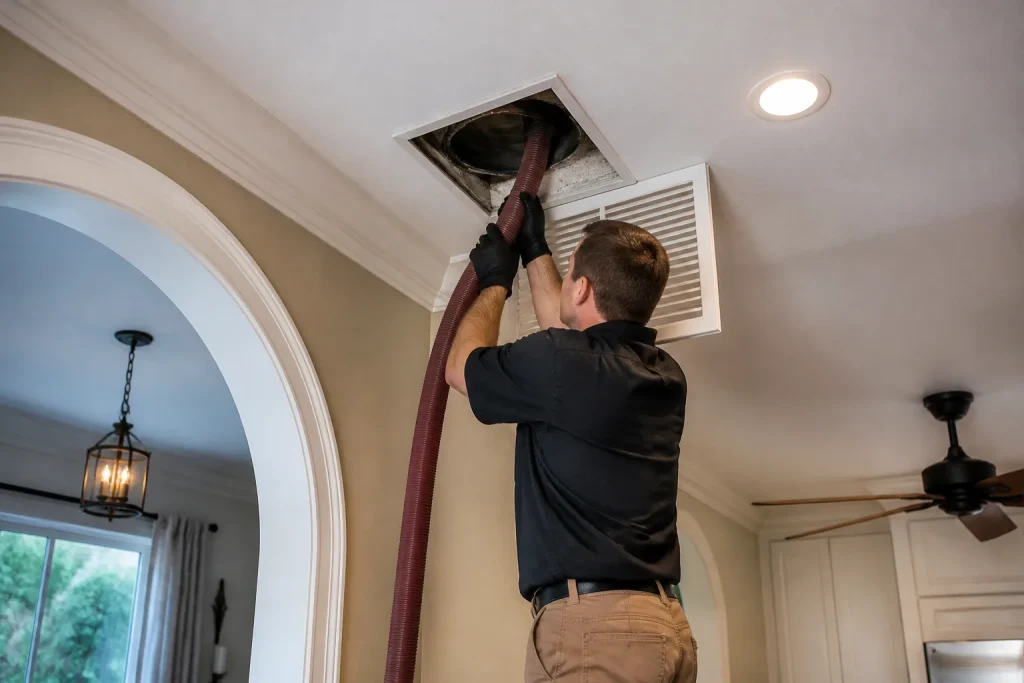
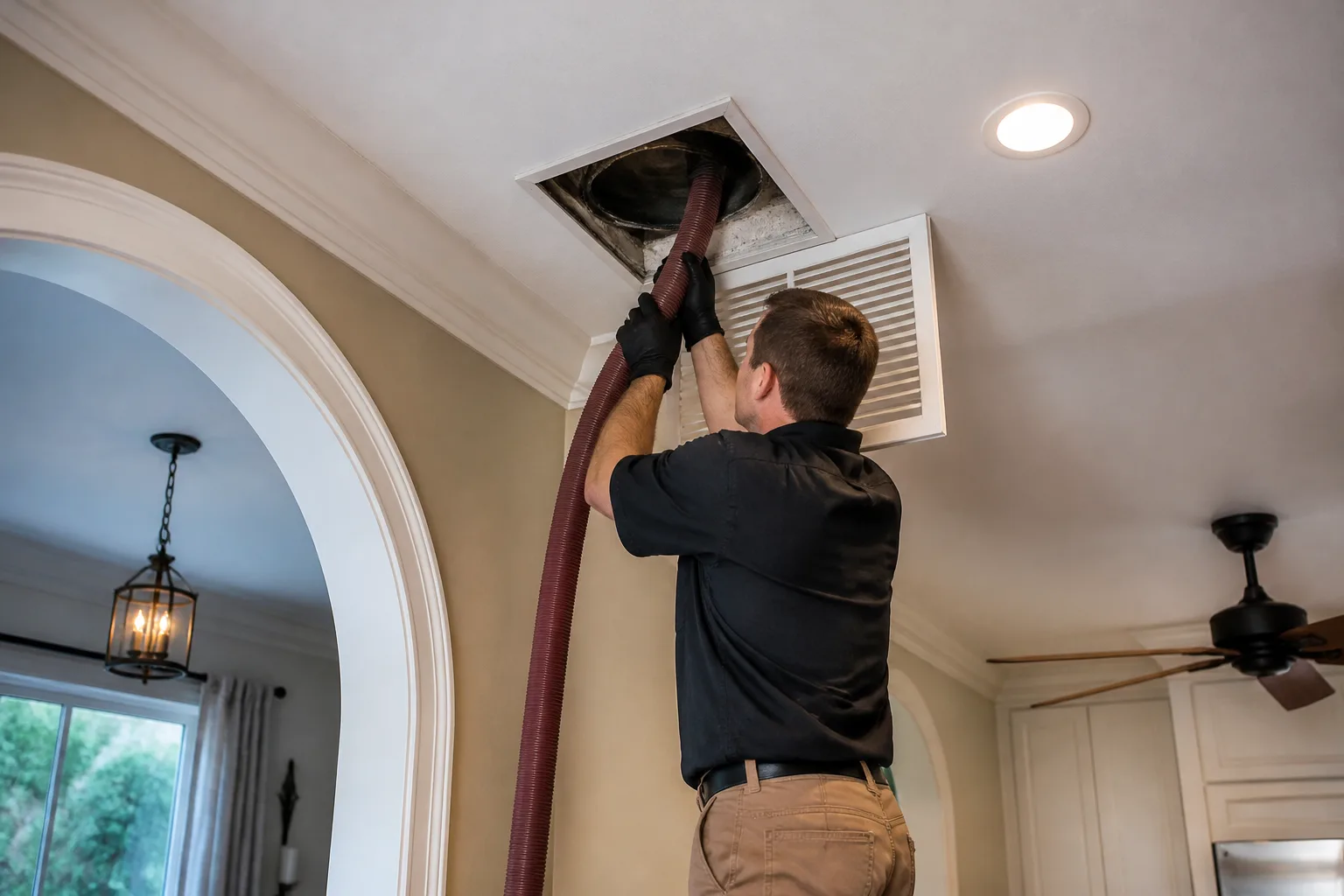
- Clean. Only now does the rotary brush and HEPA capture sequence make sense.
- Repair what the cleaning exposed. Breaches and disconnects get fixed or the contamination comes right back.
That sequence is why we treat duct repair and duct cleaning as one conversation. A crew that can only clean will flag a breach and leave you to find someone else. We’d rather fix it on the same visit.
How Do You Know If It’s a Real Emergency or Just Urgent?
A true emergency means contamination is actively spreading or a health hazard is present right now. Urgent means you need it handled soon, but the house isn’t getting worse by the hour.
Call it a genuine emergency in New Orleans if you see any of these:
- Standing water inside the ducts. Not dampness. Water you can see or hear moving in a run.
- Confirmed sewage contact. A sewage backup that reached the duct system introduces pathogens that need proper remediation, not a standard cleaning.
- Active mold growth at the registers. Visible mold at the supply or return grilles usually means it’s growing deeper inside too.
- The HVAC system is pushing a strong musty or sewage odor into every room. That means contaminated air is being distributed, not contained.
Urgent-but-not-emergency looks different: a dusty smell that’s been building for weeks, visible debris at the grilles but no moisture, or a recent renovation that left drywall dust in the system. Those need professional cleaning, but they don’t need it in the next hour.
Being honest about which one you’re facing saves money and stress. It also keeps you from paying for a rushed job on a system that would be better served by a proper inspection first. If you’re not sure which category you’re in, describe what you’re seeing and we’ll help you sort it out.
Should You Run the HVAC in the Meantime?
Default to off. If water, sewage, or visible mold has reached the ductwork, running the system spreads contamination to every room it serves.
The logic is simple. A forced-air system is a distribution network. Whatever’s in the ducts gets carried to the supply registers in every conditioned space. That’s the whole point of the system when the ducts are clean. When they’re contaminated, the same mechanism works against you.
What about fan-only mode? Fan-only circulates air without heating or cooling, and in some situations that’s the right call because it moves air through the filtration path and can help with drying. In others it’s exactly wrong, because it pushes contaminated air through a system that hasn’t been cleaned yet. The choice depends on where the moisture and contamination are and whether the system is dry. That’s a judgment call to make with someone who understands both ductwork and air movement, not a guess made in a panic.
If you’ve had a flood event and you’re unsure, leave the system off until someone looks at it. A few uncomfortable days beat redistributing sewage-contaminated air throughout a New Orleans home.
What Should You Document Before Anyone Cleans?
Document everything before a single tool comes out of the truck. Photos, moisture readings, and odor notes protect your insurance claim and give you a way to verify the job was actually done.
Capture this before any emergency cleaning begins:
- Photos of the water line. Every register, every visible duct surface, and the source of the water. Timestamped phone photos work fine.
- Photos of any visible mold at registers and grilles, from a distance and up close.
- Moisture readings if you have access to a meter, or a professional’s readings written down and dated.
- An odor map. Note which rooms smell worst, and whether the smell is stronger when the system runs. That single detail tells an inspector a lot about where the problem sits.
- A written record of what happened and when the flood or backup occurred.
These records do two jobs. They give an insurer a clear before-picture, and they give you a baseline to measure the finished work against. When a crew tells you the ducts are clean, you can compare the before photos, the moisture readings, and the smell in each room to where you started. Request before-and-after photos of your own ducts as part of the job. Any crew confident in its equipment should be happy to provide them.
Documentation is also how you catch a half-finished job. We’ve heard from homeowners who paid for a cleaning and couldn’t tell whether anything had changed. That shouldn’t be possible.
How Do You Vet a Company Claiming Emergency Duct Service?
Post-flood duct work calls for remediation-grade equipment, not a shop vac and a promise. Ask what machinery will actually be in your home.
The questions that separate a real post-flood duct crew from a generalist:
- What equipment are you bringing? Rotary brush agitation plus HEPA vacuum capture is the baseline. Rotobrush handles the agitation and reaches the duct walls; Nikro HEPA equipment captures what’s loosened. For post-flood work, Abatement Technologies filtration equipment adds a remediation-grade standard of contaminant capture. A crew that can’t name its equipment is usually improvising.
- Can you repair a breach, or only clean? Flood events expose disconnected runs and deteriorated joints. If the crew can’t fix ductwork, you’ll need a second contractor, which means a second disruption.
- How will you verify drying before cleaning? A crew that doesn’t check moisture before cleaning is the crew that causes mold recurrence.
- Will you put anything in place to protect the result? Guardsman-grade protective products help the cleaning hold. Ask whether they’re part of the job.
- Can you upgrade filtration while you’re here? As an authorized supplier and installer of Honeywell and Aprilaire air quality systems, we can add whole-home filtration in the same visit rather than sending you hunting for a second contractor afterward.
We don’t perform general HVAC repair or installation beyond ductwork, and we say so. That focus is the point: our whole operation is built around ducts, dryer vents, and indoor air quality. A generalist adding duct cleaning to a long service list is a different kind of business.
When to Call a Pro
Call a professional when the ducts themselves are wet, when sewage reached them, when you see mold at the registers, or when the system is pushing a bad smell into every room. Those are the situations where the wrong first step costs you the most.
For a dust problem with no moisture, no visible mold, and no recent flood, you can take your time and schedule a proper assessment. For anything on the emergency list, describe what you’re seeing before you book anyone.
Related services in New Orleans: air duct cleaning for routine and post-event cleaning, dryer vent cleaning to handle the other lint-choked vent in your home that most people forget, and our full range of services on the main New Orleans Duct Cleaning page.
The Bottom Line
After a flood or HVAC failure, the sequence is moisture control, drying verification, inspection, cleaning, then repair. Skipping the drying step is what causes mold to return days after a cleaning, and it’s the mistake that forces homeowners to pay twice. Understand whether your situation is a true emergency or urgent, keep the system off until you know, and document everything before anyone starts work. Then hire a crew with the equipment to actually do post-flood remediation work.
If you’re in New Orleans and need help, New Orleans Duct Cleaning offers free estimates. Call (833) 749-5104. We answer 24/7. Fast dispatch from 7am to 7pm, Sunday through Friday.
Frequently Asked Questions
Not until the moisture source is stopped and the system is verified dry. Cleaning wet ducts causes mold to return within days. Stop the water, dry the system, confirm with moisture readings, inspect, then clean. Call (833) 749-5104 for an exact plan.
Generally no. Running the system spreads contamination through every register it serves. Leave it off until someone confirms whether the ducts are dry and clean. Call (833) 749-5104 and describe what you’re seeing. Estimates are free.
Pricing is set per system by a written estimate, because a post-flood job with duct repair is not the same scope as routine cleaning. Ask for one flat price per system agreed before work starts, so there are no surprise line items once the crew is on site. Call (833) 749-5104 for an exact quote.
Cheap quotes usually leave out the drying verification, the HEPA capture step, or the duct repair that flood events tend to require. A shop vac and a promise costs less than Rotobrush agitation paired with Nikro HEPA capture for a reason. Ask what equipment is included and request before-and-after photos of your own ducts. Call (833) 749-5104 to compare honestly.
Written by the team at New Orleans Duct Cleaning.
Need Air Duct Cleaning Help?
Call New Orleans Duct Cleaning - licensed & insured, here with fast help in New Orleans.
(833) 749-5104